


Data is the lifeblood of modern business. Every transaction, click, and customer interaction generates a piece of digital information that, when stitched together, tells the story of your organisation’s health.
However, having access to data and actually using it are two very different things.
This is where data integration enters.
Data integration is the process of combining data from different sources into a single, unified view.
Without it, your marketing team might be looking at one set of numbers while your finance team looks at another. To solve this, businesses rely on sophisticated tools to manage their data pipelines. Vendors like Qlik have pioneered this space. The software offers robust capabilities from automated change data capture (CDC) to streaming that ensure your data is accurate and accessible.
But before you can integrate your data, you need a place to put it. This brings us to a common point of confusion for many business leaders: the storage architecture. If you have ever nodded along while IT discusses “lakes” and “warehouses” without fully knowing the difference, you are not alone.
Let’s simplify the technical jargon.
This guide will break down the concepts of a data lake vs data warehouse, helping you understand which architecture (or combination thereof) is right for your business.
Data Lake vs Data Warehouse | What’s The Difference?
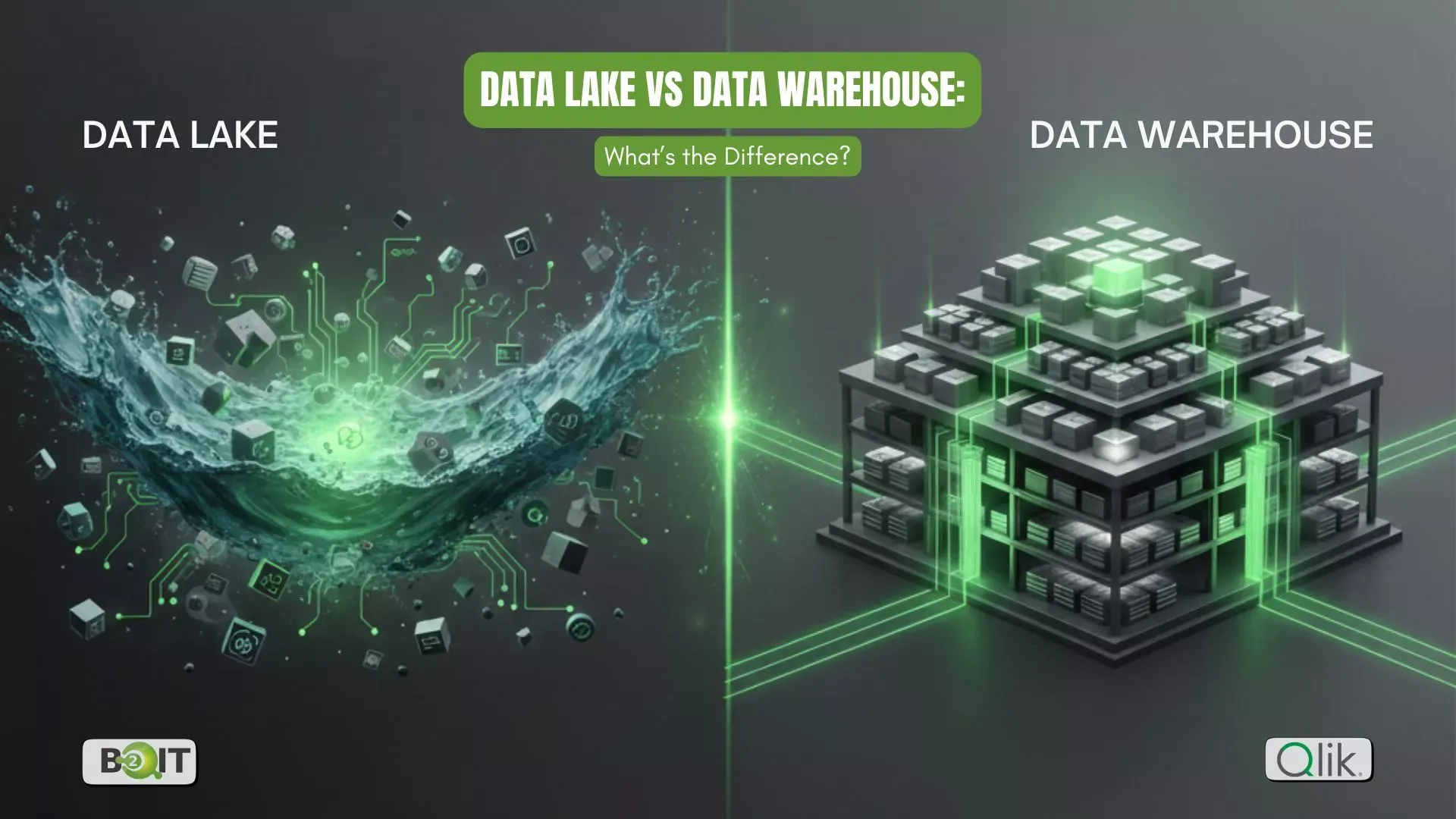
At a high level, the primary difference lies in how data is processed and stored. One stores raw data for flexible future use, while the other stores processed data for specific, immediate analysis.
To understand this better, we need to look at each one individually.
What is a Data Lake?
A data lake is a centralised repository that allows you to store all your structured and unstructured data at any scale. Think of it quite literally as a natural lake. Water (data) flows into it from various streams (sources) in its natural state. It effectively holds a vast amount of raw data in its native format until it is needed.
Because it accepts data in its original form, a data lake is incredibly flexible. It does not require you to define the purpose of the data before you store it.
You can hold everything from simple spreadsheet rows to complex video files, social media logs, and IoT sensor readings.
How does a Data Lake Work?
Data lakes generally operate on a principle known as ELT (Extract, Load, Transform).
- Extract: Data is pulled from the original source.
- Load: It is immediately loaded into the lake in its raw format.
- Transform: The data is only processed and transformed when a user extracts it for analysis.
This process utilises “Schema-on-Read.” This means the structure (schema) of the data is not defined when the data is captured, but rather when it is read by an application or user. This makes data lakes ideal for data scientists who need to explore raw datasets to find new patterns or train machine learning models.
What is a Data Warehouse?
A data warehouse is a repository for structured, filtered data that has been processed for a specific purpose. If a data lake is a natural body of water, a data warehouse is a bottling plant. The water has been filtered, purified, bottled, and placed on specific shelves.
Data warehouses are designed to support business intelligence (BI) activities, such as reporting and data analysis.
They contain historical transaction data, but unlike the lake, this data is cleaned and organised to serve as a “single source of truth” for the organisation.
How does a Data Warehouse Work?
Data warehouses typically use an ETL (Extract, Transform, Load) process.
- Extract: Data is pulled from source systems.
- Transform: The data is cleaned, formatted, and structured according to a predefined schema.
- Load: The processed data is then loaded into the warehouse.
This is known as “Schema-on-Write.” Because the structure is defined before the data is stored, the data is highly organised. This structure allows business analysts to generate reports and queries incredibly fast because the system knows exactly where to look, and the data format is consistent.
So, what is the difference between the two?
While both storage options serve the ultimate goal of data analysis, they do so in very different ways.
Here is a breakdown of the six key differences between a data lake vs data warehouse.
| Feature | Data Lake | Data Warehouse |
| 1. Data Storage | Stores all data in its raw, unstructured, or semi-structured form. It can be stored indefinitely for future use. | Stores structured data that has been cleaned, processed, and organised for specific business purposes. |
| 2. Users | Typically used by data scientists and data engineers who need to explore raw data to find new insights or build ML models. | Accessed by business analysts and operational managers looking for answers to predefined questions (KPIs, reports). |
| 3. Analysis | Ideal for predictive analytics, machine learning, deep learning, and big data exploration. | Best for historical analysis, data visualisation, and business intelligence (BI). |
| 4. Schema | Schema-on-Read: The structure is defined only when the data is queried or analysed. | Schema-on-Write: The structure is defined before the data is stored, ensuring consistency. |
| 5. Processing | ELT (Extract, Load, Transform). Data is loaded first and transformed later. | ETL (Extract, Transform, Load). Data is cleaned and structured before entering the warehouse. |
| 6. Cost | Generally lower storage costs as it utilises low-cost object storage for vast volumes of data. | Typically higher costs due to the need for faster, more complex storage infrastructure and management time. |
Which One Do You Need For Your Business?
The question of “data lake vs data warehouse” is often a false dichotomy. For most modern enterprises, the answer is not one or the other. It is both.
They typically work in tandem to provide a holistic data strategy. You might use a data lake to capture high-volume, high-velocity data from your website logs or mobile apps.
Data scientists can then explore this lake to find trends. Once a useful trend or metric is identified and standardised, that specific slice of data can be processed and moved into a data warehouse.
From there, it becomes accessible to the wider business for daily reporting and operational dashboards.
You need a Data Lake if:
- You deal with massive amounts of unstructured data (IoT, social media, images).
- Your focus is on machine learning and predictive analytics.
- You want to store data now, but haven’t defined its specific purpose yet.
You need a Data Warehouse if:
- You rely on structured data for operational reporting.
- You need high-performance queries for Business Intelligence tools.
- You require a “single version of the truth” for regulatory compliance or financial reporting.
Companies are also looking toward the “Data Lakehouse,” a hybrid architecture that combines the flexibility of a lake with the management structure of a warehouse, often powered by technologies like Qlik’s data integration platform.
B2IT | Data Integration Tool Supplier in SA
Navigating the complexities of data architecture requires more than just theory; it requires the right tools and expertise.
B2IT is a leading software solutions provider based in South Africa, specialising in helping businesses manage their data journey. With a track record boasting zero failed implementations, we ensure your organisation is equipped with a unified structure for success.
We are a registered partner of industry leaders, including Qlik, UiPath, and Microsoft.
Whether you need to automate your data warehouse lifecycle, create a managed data lake, or implement robotic process automation (RPA), our team has the local expertise to guide you.
Don’t let your data sit idle.
Contact us today to discuss your architecture needs or book a demo.
0 Comments