


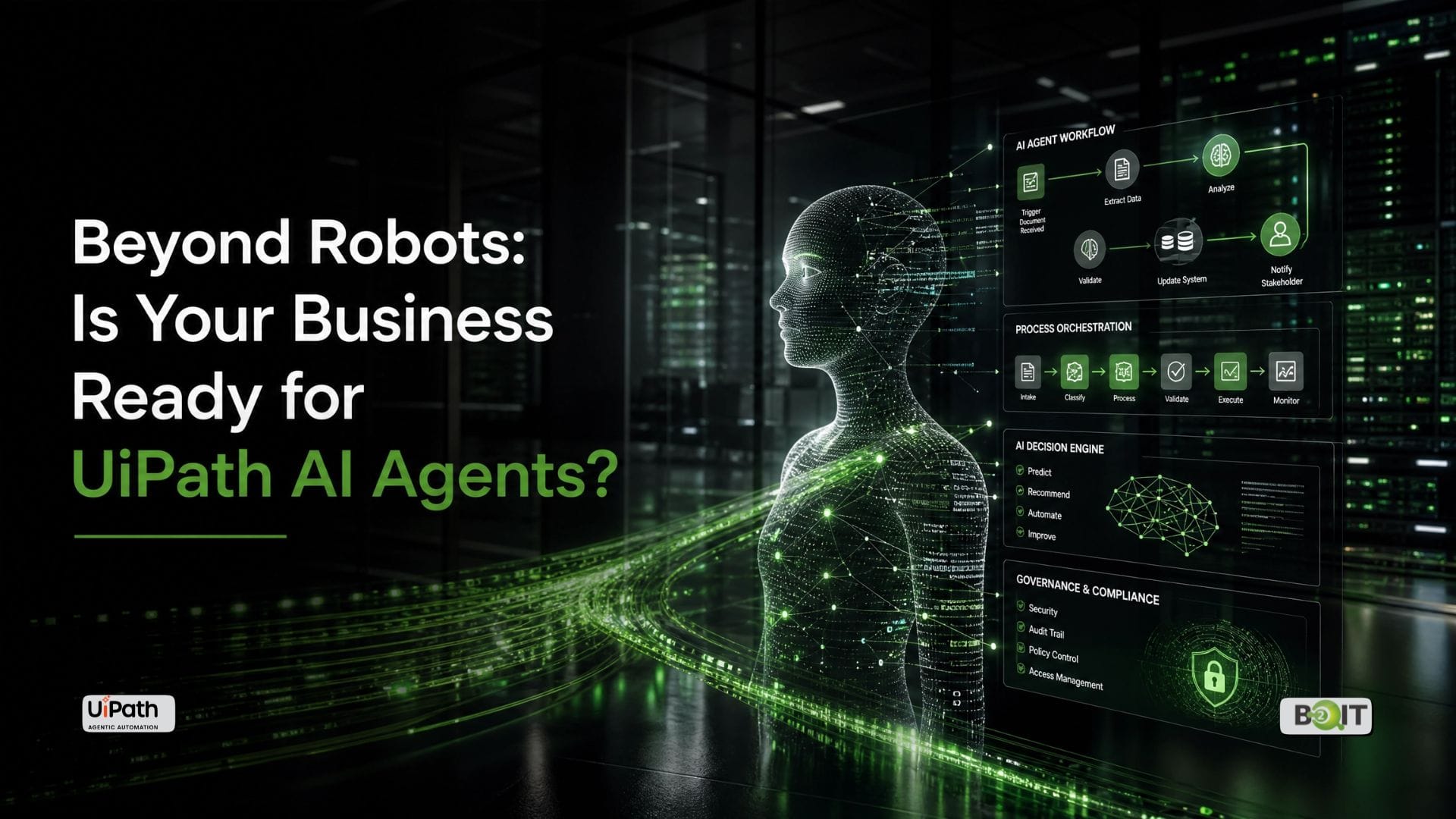
The era of relying solely on basic automation is ending. While traditional software robots have transformed operations by handling repetitive tasks, the next step in this technological evolution is here. For business owners in South Africa, staying competitive means understanding how advanced artificial intelligence can handle complex, judgment-based work.
This post explores exactly what these intelligent systems offer and asks a crucial question: Is your business ready for UiPath AI agents?
What Are UiPath AI Agents?
UiPath AI agents are advanced software systems that perceive their environment, reason toward specific objectives, and execute complex, multi-step tasks.
Unlike standard robotic process automation (RPA) that follows strict, predefined rules, AI agents can make decisions. They use large language models (LLMs) and advanced machine learning to adapt to unstructured data and changing contexts.
Why It Matters Now: Moving Beyond Robots
Traditional robots are excellent at executing repetitive, rule-based tasks with perfect accuracy, but they lack the ability to think. AI agents bridge this gap, bringing true AI in business to life.
Here is why upgrading from simple bots to intelligent agents is essential:
- Adaptive problem-solving: Agents adjust to new information without needing manual reprogramming when a process slightly changes.
- Handling unstructured data: They easily process emails, complex documents, and conversational text.
- Autonomous decision-making: They evaluate different options and trade-offs to find the most efficient path to a defined goal.
- Continuous learning: Agents improve their performance over time by analysing past outcomes and adjusting their future behaviour.
How AI Agents Work in a Business Setting
To understand how to deploy these tools, it helps to look at their core operational loop.
Here is how AI agents function in a real-world environment:
- Perception: They gather context by reading documents, accessing enterprise databases, or interpreting natural language requests from users.
- Reasoning: They determine the best course of action by evaluating the current data against their primary goals and business rules.
- Action: They execute the necessary steps. Often, they will orchestrate traditional RPA robots to perform specific system clicks or data entries on their behalf.
- Feedback: They review the results of their actions, learning what worked well to refine their approach for the next task.
Is Your Business Ready for UiPath AI Agents?
Integrating AI agents requires a solid digital foundation. You need to assess your current processes to determine whether they could benefit from autonomous decision-making.
Consider a customer service scenario.
If your team is overwhelmed by complex support tickets that require context and judgment, an AI agent can autonomously triage the issue, research the customer’s history, and draft a tailored resolution.
Alternatively, look at supply chain management.
If unexpected disruptions constantly force manual inventory rerouting, an agent can automatically analyse logistics data, predict shortages, and initiate corrective system updates before a crisis occurs.
If your digital processes are well-documented and you have clear governance policies in place, you are likely ready to upgrade from robots to these intelligent systems.
B2IT | Your UiPath Partners in SA
Embracing the future of automation requires the right guidance.
As registered UiPath partners in South Africa, B2IT offers the local expertise needed to implement these advanced solutions effectively. We help you map your workflows, set up the right AI infrastructure, and ensure a smooth transition to intelligent agentic automation.
Ready to transform your operations?
Book a demo with B2IT today and discover how we can help your business scale efficiently.
0 Comments