


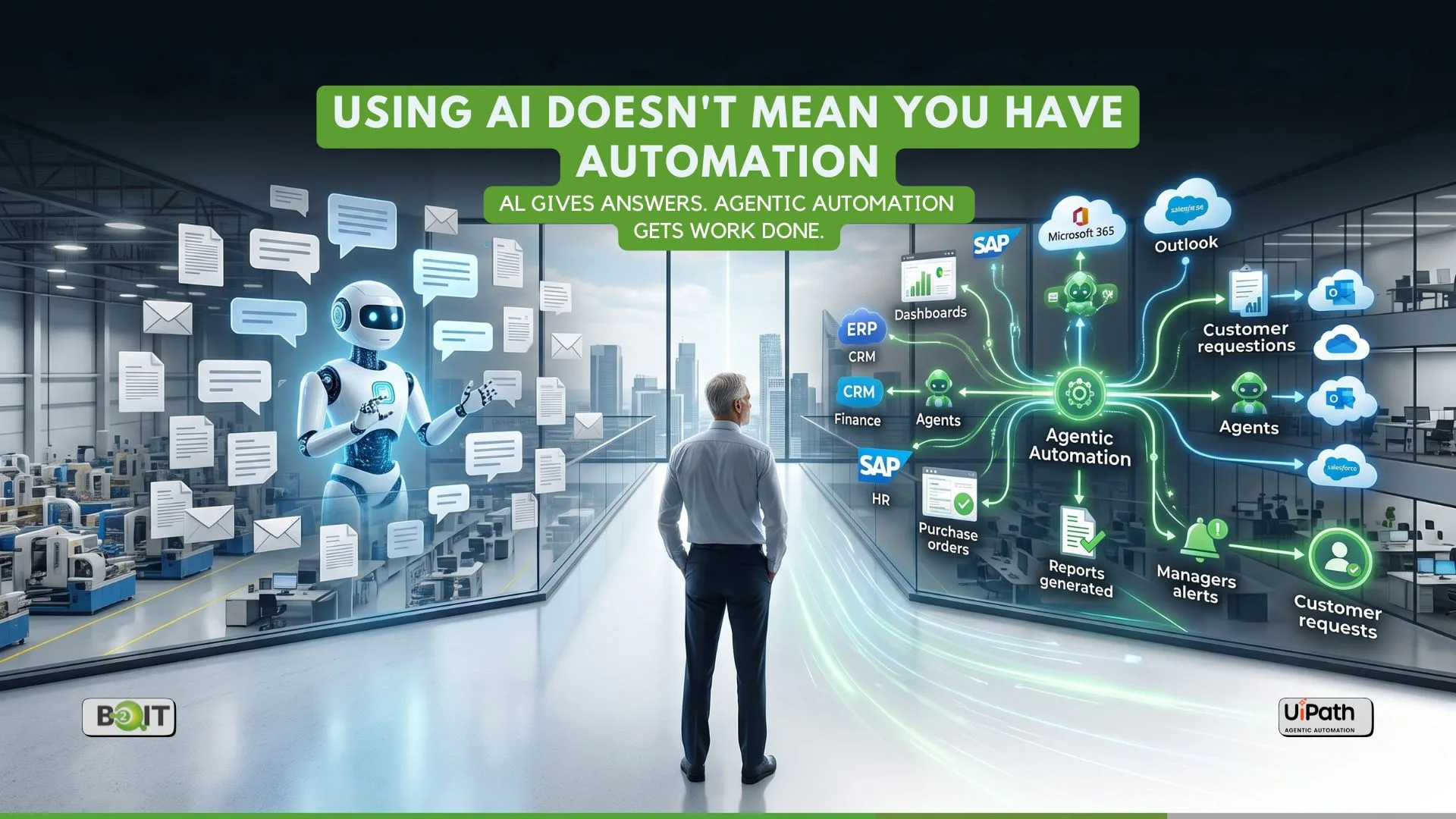
Quick answer: Traditional AI follows predefined rules to complete specific tasks, such as detecting fraud or filtering spam. Agentic AI operates autonomously, plans multi-step workflows, and adapts in real time to achieve complex goals with little to no human direction. Both have distinct roles in modern business operations.
Not all AI is the same.
As AI adoption accelerates across industries, two distinct types are shaping how businesses operate: traditional AI and agentic AI. Understanding the difference between them is essential for any organisation looking to make informed technology decisions.
This post breaks down what each type is, how they differ, and which one suits your business needs.
Traditional AI vs Agentic AI?
What Is Traditional AI?
Traditional AI refers to systems that are built around predefined rules, fixed algorithms, and labelled datasets. These systems are designed to perform specific, repeatable tasks consistently and accurately. They do not think independently or adapt to new situations without being retrained.
Examples of Traditional AI
- Spam filters that flag suspicious emails based on set rules.
- Customer service chatbots that respond using scripted answers.
- Fraud detection systems in banking that follow programmed patterns.
- Recommendation engines on e-commerce or streaming platforms.
Features of Traditional AI
- Low autonomy: Requires explicit instructions and human oversight.
- Deterministic output: Produces answers, classifications, or predictions.
- Rule-based learning: Trained on labelled data and requires retraining for new scenarios.
- Task-specific: Best suited for routine, structured processes.
- Limited adaptability: Struggles when conditions change unexpectedly.
What Is Agentic AI?
Agentic AI is a more advanced form of AI that can plan, reason, and execute multi-step tasks autonomously. Rather than waiting for instructions, agentic AI systems set their own sub-goals and adapt their approach based on new information. According to UiPath, agentic AI enables organisations to scale intelligent workflows with governed autonomy and deep enterprise integrations.
Examples of Agentic AI
- Work order agents that analyse requests, allocate resources, and respond automatically.
- Accounts payable agents that extract invoice data, check records, and send replies without human input.
- IT monitoring agents that detect and resolve server issues in real time.
- Cybersecurity agents that identify and respond to threats as they evolve.
- Qlik Cloud Analytics agents that monitor data and trigger actions across business workflows.
Features of Agentic AI
- High autonomy: Plans, decides, and acts with minimal human direction.
- Multi-step output: Executes complex workflows and makes decisions as situations change.
- Real-time learning: Adapts strategies and actions based on live feedback.
- Goal-oriented: Pursues broader objectives rather than isolated tasks.
- Enterprise-scalable: Coordinates agents, robots, and workflows across whole systems.
What Are the Key Differences Between Agentic AI and Traditional AI?
Autonomy: Traditional AI operates within fixed boundaries; agentic AI directs itself.
Decision-making: Traditional AI produces deterministic results; agentic AI executes multi-step decisions.
Adaptability: Traditional AI needs retraining when conditions change; agentic AI adjusts in real time.
Task complexity: Traditional AI handles specific, routine jobs; agentic AI manages dynamic, evolving goals.
Scalability: Traditional AI requires more manual oversight as it grows; agentic AI coordinates large systems independently.
Business value: Traditional AI increases consistency; agentic AI reduces manual effort and enables personalised, proactive operations.
Which Type of AI Should You Use in Your Business?
The right choice depends on what your business needs to achieve.
Choose traditional AI if your processes are structured, repetitive, and rule-based, such as sorting emails, flagging transactions, or categorising support tickets. Traditional AI is reliable, cost-effective, and straightforward to implement for focused tasks.
Choose agentic AI if your business needs to automate complex, multi-step processes across departments, respond to changing conditions in real time, or reduce the manual workload of knowledge workers. According to Qlik’s State of Agentic AI report, 79% of enterprise leaders say agentic AI is critical to their strategy, yet only 18% have fully deployed it.
Use both together for maximum competitive advantage. Traditional AI handles structured tasks, while agentic AI manages complex, evolving workflows across the business.
Implement AI in Your Business With B2IT
B2IT is a registered Qlik partner and UiPath partner in South Africa, with a track record of zero failed implementations since 2010.
Whether your business needs structured analytics through Qlik Cloud Analytics or autonomous workflow automation through UiPath Agentic AI, B2IT can guide you from planning to deployment.
Book a demo and let B2IT help you determine which AI solution best fits your business.
Frequently Asked Questions
1. What is the main difference between traditional AI and agentic AI?
Traditional AI follows predefined rules to complete specific tasks and requires human input to function. Agentic AI operates independently, sets its own sub-goals, and adapts its approach based on new information, making it suitable for complex, multi-step business processes.
2. Is agentic AI better than traditional AI for all business use cases?
Not necessarily. Traditional AI is more effective for structured, rule-based tasks such as fraud detection or email filtering. Agentic AI is better suited to dynamic, complex workflows that require autonomous decision-making. Many organisations benefit from using both types together.
3. What industries are using agentic AI today?
Agentic AI is being used across a wide range of industries.
4. How do I know if my business is ready for agentic AI?
If your teams are spending significant time on repetitive, multi-step processes, or if you need faster responses to changing business conditions, agentic AI may be a strong fit. Speaking with a specialist partner like B2IT can help you assess readiness and identify the right starting point.
5. What tools does B2IT use to implement AI for businesses in South Africa?
B2IT implements AI solutions using Qlik Cloud Analytics for data intelligence and UiPath for agentic automation and robotic process automation.
0 Comments